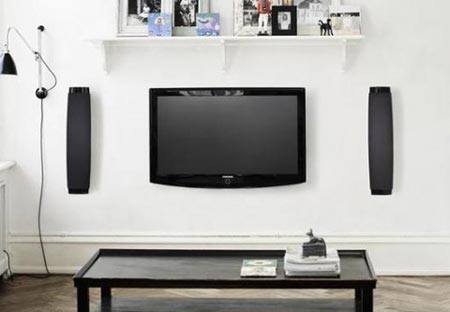
04.tvmount-1.jpgDesigned for open-plan living spaces, the new Skunkworks robotic flat screen mounting system allows you to move your plasma or LCD TV around to different rooms of the house.

The Trak-Kit system comprises of a length of track that suspends a flat screen TV of up 270kg. The screen can then be rotated or moved anywhere along the track – giving you multiple viewing points.

This is particularly useful for open-plan living spaces – in which you could move your TV from the living room position to the kitchen, for example.

Skunkworks says the "track" itself is a unique system of concave cam rollers made from smooth-running cast nylon. The rollers are housed in extruded aluminium casing and the track comes in 3 metre lengths, which can be added together to create a range of configurations.

All cables are integrated into the track housing and the speakers are incorporated into the mount in either a fixed, static position or motorised to move from behind the screen into their audio-ready position.

04.tvmount-2.jpgThe system comes in both manual and robotic models – the robotic model operates via a customised touch screen remote control. It can be pre-programmed to precise set-ups and positions. Skunkworks also suggests that the system can be used as a mobile art gallery – so you can display art work on the reverse side of the flat screen TV – smart!

Prices for a customised Skunkworks Trak-Kit system are available on request.
web site: http://www.skunkworks.com.au

Continue Reading…

 The good old USA, that country they call the land of the free is now considering locking you up if you dare to nick a music track or a piece of software without the express permission of the owner.

Details of Attorney General Alberto Gonzales' Intellectual Property Protection Act of 2007, will criminalise "attempting" to infringe copyright.

It means that you can go to prison for one to 10 years for trying to copy a music CD and failing. In another move you could get life in prison for using a pirated copy of Windows on your home PC.

It will be possible for the FBI to get a wire tap to see if you are using pirated software. Anyone who uses counterfeit products who "recklessly causes or attempts to cause death" can be sent down for life. The Justice Department says an example of this will be a hospital which uses pirated software instead of paying for it.

Homeland Security will be allowed to use its terrorist search powers on behalf of the Recording Industry Association of America (RIAA). It would notify the RIAA when its sniffers detected "unauthorised fixations of the sounds, or sounds and images, of a live musical performance" are found.

Other copyright holders will not get the benefit of this service. According to News.com, it is unclear how these new laws will be received by the Democrats. While you would think the fact that Gonzales is as popular amongst them as the Boston Strangler, they have a lot of chums in the entertainment industry who think that pirates should be sent to the gas chamber.

Nice to know that the world's richest country has such a great sense of perspective.


Continue Reading…

04.sonyrival.jpgSony has launched its rival to the Apple iPod video – its first ever Walkman video mp3 player, the A800.

"Our first ever Walkman with video support combines the best of what we know in sound and vision, it is compact and super-stylish with an impressively large (two-inch)screen  for such a small unit – it's what people have been waiting for, says Sony's Suzanna Gan.

Video footage can be viewed horizontally or vertically on the two-inch QVGA screen. Playback supports MPEG-4 and the codec of AVC Baseline profile formats, at up to 30 frames per second, Sony says.

And to improve on sound quality for the compressed audio in your player, Sony has added its new Digital Sound Enhancement Engine (DSEE) technology that it says "restores the nuances and frequencies usually lost in music like MP3 files due to
the compression process."

The new Walkman Video MP3 player's lithium-ion rechargeable battery has a claimed life of up to 30 hours continuous music or up to eight hours continuous video playback. It also allows you to store JPEG photos and create slideshows with music sound effects to match.

Available in 2GB, 4GB and 8GB versions and a choice of four colours (violet, black, white and pink), the player comes with SonicStage software for music management. They also come with a set of EX monitor headphones in the box.


Continue Reading…

04.lg.jpgLG describes its new MP3 player as a sexy, stylish device, complete with a curvaceous body and the seductive name: the Touch Me.

The Touch Me (or in boring model number terms, the FM37) features a colour LCD touch screen – something LG says is an Australian first for digital music devices – and offers video playback, voice and FM radio recording, a photo viewer and built-in games.

Housed in a "sexy, funky, metallic finish" body, the Touch Me is available in a 2GB and 4GB version and a claimed 20 hours music play and three hours of video viewing per full charge.

"Consumers are not only opting for digital devices that are easy to use, conveniently sized and technologically advanced, but are searching for a multimedia player that also reflects their personality, style and attitude.  The Touch Me is ideally designed to meet the fashion and technology needs of each individual, from the style conscious teenager and the elegantly poised businesswoman to the design freak or music mogul," said LG's Darren Goble.

Of course, whether it's 'sexy' enough to take on the ubiquitous iPod is the real question.

Continue Reading…

04.ipod.jpgApple has launched a new special edition iPod nano, which comes in the colour red to support the Product Red campaign against HIV/AIDS.

Following the heels of companies like Motorola, which recently launched its own Product Red version of its popular Razr phone, Apple will give a portion of the purchase price of the red nano to the Global Fund to fight HIV/AIDS in Africa.

Available in 4GB and 8GB models, the new iPod nano comes in a red aluminium enclosure and features the usual claimed 24 hours of battery life and Click Wheel

The special edition red iPod nano is only available at the Apple online store.

Continue Reading…

Audio product manufacturer Jabra has announced noise cancelling headphones for the Australian market.

04.jabra.jpgThe Jabra C820s remove background noise by up to 22 decibels, the manufacturer claims.

They
are powered by a single AAA battery in the ear cup and come with a
standard stereo audio cable for devices such as MP3 players or PCs.

There is also a connector cable for music phones with adapters, an airline adaptor and a 3.5mm – 6.5mm stereo adaptor.

They
can be folded flat into the supplied case to minimise damage when
traveling, and weigh less than 200 grams, making them ultra-portable.

Specifications


• Stereo headphones
• Hi-fi frequency speakers
• Active Noise Cancellation: up to 22 dB
• Active Noise Cancellation battery life: up to 50 hours
• Audio bypass function enables the delivery of compensated audio in
absence of battery
• Ear cups with premium grade leatherette pads
• Frequency response: 20 Hz to 22 kHz +/- 3dB
• Speakers: 2 x 1½ in (2 x 40 mm) neodymium
• Total Harmonic Distortion: less than 1%
• Impedance: 64 Ohm
• Weighs less than 7 oz (200 g)
• Dimensions: H 6 ⁴/5 x W 6 ²/5 x D 3 ¹/10 in (174 x 163 x 80 mm)


In the box


• Jabra C820s stereo music headphones
• Flat-pack carry case
• 3.5 mm stereo audio cables
• 2-prong airline adapter
• 3.5 mm – 6.5 mm stereo adapter
• 3.5 mm – 2.5 mm stereo adapter
• 1 x AAA battery
• User manual


Continue Reading…

Norwegian AV guru ProjectionDesign delivers DLP’s next ‘full HD’ projector. The SmartHouse Team looks on in pure admiration.

04.project-1.jpg

With both HD DVD and Blu-ray discs delivering their first movies in 1080i/p, serious AV enthusiasts – like ourselves! – are being drawn ever more towards display devices with native pixel counts of 1920 x 1080. So it's fair to say that we were seriously excited by the arrival of the Action Model Three 1080: the second 1080p DLP projector to arrive at the doors of SmartHouse, following the SIM2 HT3000.
It's actually a surprise SIM2 hit our pages first, since, for a long time during the two projectors' development, projectiondesign seemed to be slightly ahead of the opposition. But ultimately the extra complexities of the PD model – it does, after all, cost six grand more than the SIM2 – seems to have lost them the top slot.
Actually, now we've mentioned the Model Three 1080's price – all $41,750 with a Standard 1.6 to 2.3:1 lens and VPS33000 scaler– it probably makes sense to try and explain just why PD thinks its projector is really worth that much.

04.project-2.jpg
Features
Actually manufacturing a 1920 x 1080 native DLP chipset is a wee bit tricky – not surprising when you consider that such a device needs to fit over two million independently controllable mirrors onto the back of a single controlling chipset. But of course, SIM2's cheaper 1080 DLP model uses the same chipset, so that alone can't explain the price.
So for more justification, let's turn to the Model Three 1080's second box. For yes, even though it's one of the chunkiest projectors around (the exact opposite of PD's usually strikingly diminutive projectors), it still can't fit in all the processing PD wanted to provide with its single-chip flagship. {mospagebreak}
This second control/processing/connections box tellingly comes badged with the words Crystalio II, the name for a box of tricks from Pixel Magic that's respected the world over for its image processing talents, driven by the Gennum VXP video scaling system (or the Faroudja DCDi process, which is also included).
The inclusion of this processor shows how important it is to PD that you get the best out of the Action Model Three 1080. For the Crystalio box can take in any video signal, of any resolution, and upconvert it to 1080p before feeding it via a digital output to the 1080-hungry Model Three's optics. The key explanation for the PD's hefty price tag, though, is the fact that it uses two lamps and two separate 7-segment DLP colour wheels/light formatters.
This phenomenally complex dual light approach is made possible by PD's patented DuArch technology, and should result in outstanding contrast and brightness, as well as far greater control over brightness levels since both lamps can be controlled separately.
To put some numbers on this, the projector claims a ‘true optical' contrast ratio of 7,500:1, and a maximum brightness potential right up to 2500 ANSI Lumens (making it capable of driving truly immense screen sizes).
We could harp on for pages about all the fancy shenanigans going on inside the Model Three 1080, and especially the Crystalio box. But we'll content ourselves to a mention of Texas Instrument's new Spoke Light Recapture technology for improving colour reproduction, especially in secondary colours; and more colour improvement from PD's own RealColour colour management system.
The Crystalio box is positively oozing with connections, including four HDMI inputs, four component inputs, PC BNC inputs, two SDI inputs, USB and Ethernet ports. And we should also add that the projector can be bought with any of six different lenses, ranging from an ultra-wide angle 0.79:1 for near projection to the super tele-zoom at 3.8-6.5:1.

Performance
As we fire the Model Three 1080 up, we can't help but wonder if PD really has managed to nail the combination of high-end third-party processing, new DMD chipset, and DuArch technology so soon. Happily, such concerns are immediately squashed, as the Model Three 1080 produces a picture quality that's extraordinarily good.
The fine detail and texture displayed in the image is nothing short of revelatory, with the projector regularly showing minute elements in our favourite 1080i HD sources that we didn't even realise were there before.
Part of this astounding clarity is doubtless down to the sheer pixel count that the Model Three's image contains. But credit must also go to the remarkable lack of noise that's visible in the picture, which dramatically proves both the benefits of a) matching the native DMD resolution to the source image's native resolution, and b) the considerable prowess of the Crystalio II processing engine.
Yet more proof of just how good – and intelligent – every element of the Model Three 1080's optics and processing is can be seen in the way it clearly reveals the difference (in terms of stability and even more texture) of between 1080p and 1080i sources.
Incred ibly though, it's not just high-def's friend. The Crystalio box also does a mind-bogglingly good job of upscaling standard-definition sources – anything above a composite feed, anyway – to fit the projector's 1080p preference. The SIM2 excelled in this regard, but we'd argue the PD is even slightly better.
Also setting the Model Three 1080 apart is its DuArch-inspired combination of extreme brightness and hugely expansive contrast – a combination which aids the projector in producing richer, more detailed and more subtly greyscaled dark areas than we've ever seen before, certainly on a single-chip projector.
The trouble projectiondesign has gone to in the name of colours pays off handsomely too, with a pretty much picture perfect palette with all types of source image.
The only downers we could see with this projector are minor. First, the need for two colour wheels, and to cool two separate lamps, means the unit makes quite a whirring noise, and second, fast moving objects occasionally look fractionally indistinct. Though this is true to some extent, of course, with all DLP models.
However, in regards to the noise, Rod Sommerich of the product's Australian distributor, Amber Technology, says if you only use one lamp, then the colourwheel also stops turning so you will notice a reduction on the unit's noise.

04.project-3.jpg

Conclusion
It might be big, expensive and even ugly, but the best way to sum up the Model Three 1080 is to say that it really does deliver the closest experience to actually going to a good commercial cinema that we have yet seen – only without the usual scratches and dirt specks over the picture! In fact, Sommerich says projectiondesign has begun delivering over 800 projectors to all cinemas in Scandinavia for E-Cinema use, and in Australia, Amber has delivered a number of units to major post production facilities for colour grading and editing use and to an Australian television network for program monitoring in their main presentation control rooms. Several of the 720P version of the product are in commercial cinemas in Australia and New Zealand also.
Overall, this projector is an excellent ambassador for 1080p high-definition.

Continue Reading…

Runco, arguably the high-end projection television
brand, has been acquired by Beaverton, Oregon-based Planar Systems in a cash
deal worth $36.7 million.

Sam and Laurie Runco founded Runco International in 1987 though the Runco brand
goes back to the 1970s. In 1972, Sam used a fresnel lens to magnify the picture
from a 15-inch television. Today the company is a favorite among videophiles
and custom installers.

04.runco.jpgAmong the company's first products was the Runco International HT, which
stood for home theater, a term Sam is believed to have coined. He trademarked
the phrase home theater in 1990.

Runco made a name for itself in CRT-based front-projection systems and the
company's tube-based products are still regarded as the gold standard in video
projection. However, Runco also lent a hand in developing DLP projection
technology and has marketed LCD projectors, plasmas, video processors, and
other products.

Runco will become one of the parent company's three brands, in addition to
Planar and Vidikron.

"Sam Runco and his wife Laurie will remain attached to our hip as they
always have been as consultants for the business in multiple fashions, from
brand to channel management, media relations and technology," Planar VP
Scott Hix told TWICE.

Continue Reading…

Jay Basen and Lance David—programming manager and director of custom
sales and installation, respectively, of Gramophone in Timonium,
Maryland—see several new trends developing in the home theater market.
The first is that more and more homeowners are not only putting
dedicated home theaters into their homes, but they're putting in more
advanced home theaters. "Many more options are available or are coming
out. We now have access to new high-definition content, and price
points are coming down. These factors, combined with the sophistication
of customers, are driving high performance," says Basen. According to
David, homeowners are now recognizing the value of systems integration
with a centralized control system, and they're paying more attention to
acoustics, as well as the less sexy but still very important aspects of
proper ventilation and energy management. This gorgeous theater and
wholehouse system in a 16,000-square-foot home in Highland, Maryland,
embodies all of these growing trends.

04.c_control_1.jpg

The home is very traditional in appearance, with a mixed stone and
stucco exterior. The home theater resides in the basement, where it was
designed into the architectural floor plans from the beginning stages.
After the construction team poured the foundation and began work on the
basement theater, however, they realized that the room needed to be
bigger from top to bottom. Because the basement was the lowest point in
the home, an excavation was necessary in order to provide proper
drainage and accommodate the risers that the homeowners wanted in the
theater. With the help of builder Neil Garner of Pinecrest Builders,
the excavation went off without a hitch.

The homeowners have three young children, and they wanted a place where
the family could get together to enjoy not only movies in a dedicated,
high-performance atmosphere, but their kids' performances, as well.
Thus, the theater has a built-in stage, complete with theatrical
lighting—red, blue, green, and yellow—that can be accessed through the
Lutron lighting-control system. There are even two stage balconies
where the children can act out plays such as Romeo and Juliet or
Rapunzel. Eventually, the homeowners want to add a karaoke machine.
This room is a true theater, not just a place to watch movies.
The creative inspiration that guided the homeowners and helped them get
a top-notch space was a blessing, but it was also one of the big-
gest challenges for Gramophone. "The creativity of the homeowner was a
challenge," says Basen. "He is very sophisticated. As he learned more
about what could be done, his mind began to work, and he realized the
sky was basically the limit." This is reflected primarily in the home's
award-winning lighting and control system. When you are sitting in the
theater, the Crestron TPS-3000 touchscreen will come to life when a car
comes into the driveway. A front-door camera will display on the
touchscreen when the doorbell rings, and the wholehouse intercom allows
you to communicate with the person at the front door from the
basement—so, even in the lower reaches of the home, you don't feel
disconnected. If you want to let the person in, the door locks are all
electrically controlled, so you can unlock the door from where you sit.

04.c_control_2.jpg

The house has a backup generator, and the homeowners had some issues
with it. When they realized that it was possible to do amazing things
with the control system, the homeowners asked if it was possible to
monitor the generator through the automation system. Now, the generator
automatically performs a weekly load test, and, if there is a problem,
the system sends an e-mail to the homeowner's cell phone. "As they were
struck with great ideas along the journey, if we could do it, we did,
although it did add to the length of the project" says Basen.
The tricked-out control system has a tricked-out theater to go with it.
The video system includes a Runco VX-2c three-chip DLP projector and a
Stewart Filmscreen FireHawk electric four-way-masking screen. The
screen lowers from above the stage and behind the proscenium.

04.c_control_3.jpg

A Kaleidescape movie server stores 2 terabytes of movies, and,
when a movie comes on, the screen automatically masks to create the
correct aspect ratio. "What a great impact this makes on the audience;
what a finish it gives to the performance," says David. "When the image
on the screen fits the screen with no gray bars, it makes all the
difference." The projector resides in the hallway behind the theater.
It is built into the ceiling behind a theater-grade aperture with full
access and conduit for future upgrades and a heating and ventilation
system. "My advice to those building a theater," says David, "is to get
an idea of how long certain things take. For example, theater chairs
can have a 12-week time line, carpeting needs to be ordered in advance,
and so on. As long as this particular client got value for the money,
he considered it worth the wait."

04.c_control_4.jpg

The audio is equally as stunning as the video, with B&W
speakers in a seven-channel array hidden behind acoustic panels in the
room. A Lexicon MC-8 pre/pro and LX-7 seven-channel amp handle surround
processing and amplification duties. There are no less than six other
surround sound systems in the home, some with B&Ws, others with
in-ceiling or in-wall SpeakerCraft models.
"Ventilation is a huge part of keeping an advanced system running
smoothly," says David. "This system automatically runs diagnostics on a
periodic basis to make sure that all components are running optimally.
Preventive maintenance diagnostics are very important." It becomes even
more important when you have five component racks dedicated to
wholehouse equipment and a dedicated equipment room for the theater.
Likewise, the dedicated theater has a discrete air-conditioning system
and full humidity control because it is below ground, which can be a
high-humidity environment.

04.c_control_5.jpg

The 25-by-40-foot room presented a few acoustic challenges that
Acoustic Innovations corrected. "Clients are paying more attention to
the benefits of proper acoustics in the room, including proper sound
and proper isolation," says David. "They experience theaters in other
homes where care was not taken and can hear the difference." Gramophone
now offers acoustical-design services.
The homeowners are so happy with the way their wholehouse A/V system
and dedicated theater perform that they are incorporating similar
systems into their beach house and business offices—and rightly so. By
any standards, this is a stellar system, winning a Bronze Electronic
Lifestyle Award from CEDIA for Best Integrated Home, not to mention
awards from both Crestron and Lutron.

04.c_control_6.jpg

Advice From the Pros

Gramophone's Lance David provides some helpful tips for working on your
own theater.
"Interior designers don't generally make good theater designers," says
Lance David. "Likewise, theater designers might not be well equipped to
design your entire house. There are specialized theater-interior
designers whose resources and talents are specific to theaters. Seek
one out if you are considering outside help for your theater." The one
in this story was designed by Gramophone's creative designer, Louis
DiCrescenzo.
"Planning is important," says David. "The budget can be staggering at
first. However, homeowners are comforted upon the realization that they
can talk to the builder, the electrician, the A/V contractor, etc., to
rough-in the general plan with necessary audio/video wiring in place.
So, even if the theater doesn't get finished, the entire infrastructure
is there to do it in the future. Planning ahead—committing resources to
allow your dream theater to happen years down the road—is cost
effective." "We always recommend motorized recliners in a theater,"
says David. "We put non-motorized recliners in this theater in the
beginning, but they were hard for smaller children to use because they
required a bit of strength to operate." In this theater, there are 16
motorized Acoustic Innovations Deco theater chairs that the kids can
use with ease.

Continue Reading…